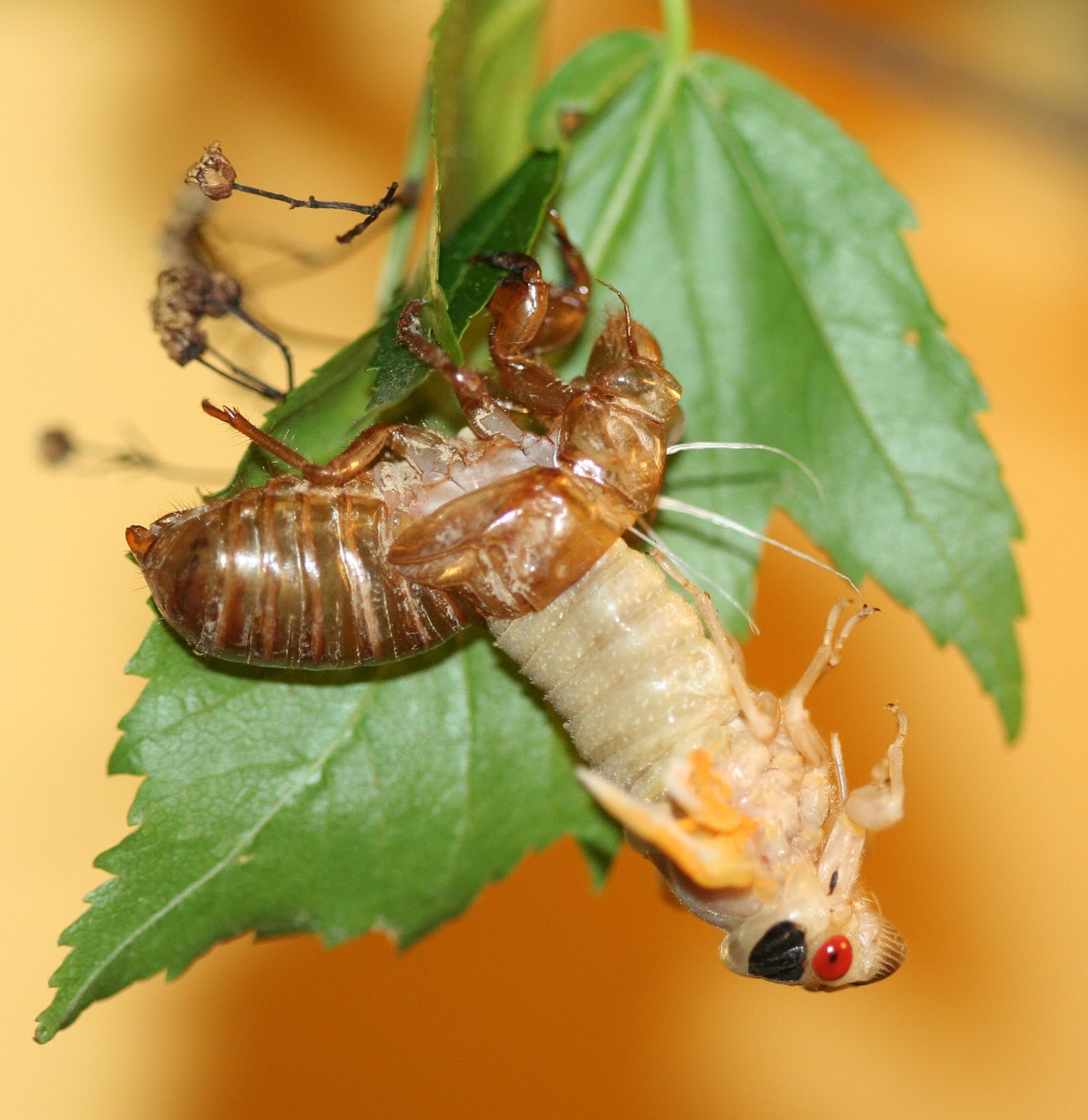
This female Magicicada septendecim Nymph was found in Wildwood State Park making its way up a tree trunk to emerge. Below are a series of photos of the nymphs emergence.Thanks goes to Elias Bonaros for his good eye in finding this one nymph in a forest full of trees and bushes!
The nymph secures itself to the leave to ready itself to emerge from its exoskeleton.
The back of the nymphs exoskeleton splits open to start the process of emergence.
The nymph hangs upside down for a short period of time so that its legs can harden so it can support its body weight.
While hanging upside down the nymphs wings begin to inflate.
When the nymphs legs harden enough it does a sit-up and grabs onto its exoskeleton.
It then pulls out the bottom part of its body.
It continues to hang from its exoskeleton to inflate its wings.
After the wings are fully inflated the nymph brings them in closer to its body.
As the nymphs exoskeleton hardens if becomes darker.
The next day the nymphs exoskeleton is fully hardened and her adult colors have developed.
Brood V Magicicada are due to emerge on Long Island after 17 years underground. The last time they were seen was in 1999. The main brood covers Maryland, Ohio, Pennsylvania, Virginia and West Virginia with a small disjunct population of Brood V emerging on Long Island. I am happy to report that Brood V Long Island has emerged with exuvia, nymphs and chorusing noted. The Magicicada septendecim has been emerging and calling this week on Long Island and efforts are underway to record their locations. If anyone observes any emergences of Brood V during June we would like to hear from you with an address or nearest cross streets. Contact info on the bottom of this Blog post.
What To Look For
Adult Magicicada septendecim on shed exuvia
Magicicada septendecim nymph female climbing tree to emerge
Please contact me at graphicartist04@gmail.com with location information for any Brood V cicada observations on Long Island or post below this Blog post. Thank You!
N. hieroglyphica is extremely difficult to find on pines, especially in the Pine Barrens. Can you find the N.h. in the photos? They blend in beautifully to the scraggly bark on the pines. Even though they feed and lay eggs on Oak trees, I still find the males, most of the time, calling from pine trees.